


Majlis Ugama Islam Singapura
Friday Sermon
13 March 2026 / 23 Ramadan 1447H
Laylatul Qadr – Seeking a Better Decree
Zumratal mukminin rahimakumullah,
Have taqwa and fear Allah s.w.t. as He should be feared. Carry out all His commands and abstain from all His prohibitions. May our taqwa towards Allah s.w.t. today serve as a source of peace when we stand before Him tomorrow. Amin ya Rabbal ‘Alamin.
Dear blessed congregation,
The last ten nights of Ramadan have arrived. As Muslims, we believe that this is an important time for us to seek a very special night, a night that is better than a thousand months – that is Laylatul Qadr.
In a narration recorded by Imam Muslim, it is mentioned that the Prophet s.a.w. exerted himself in worship during the last part of Ramadan more than at any other time. Should this not inspire the same motivation within us?
Furthermore, Allah s.w.t. says in Surah ad-Dukhan, verse 4:
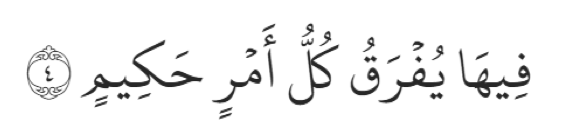
Which means: “Therein (on that night) is made distinct every precise matter.”
Brothers, according to scholars of tafsir such as Imam Ibn Kathir, this means that on Laylatul Qadr, all matters such as provision, trials, and events for the coming year are distinguished and apportioned by Allah s.w.t.
Beloved brothers,
Indeed, a believer would never take lightly the immense virtue of Laylatul Qadr, especially with the awareness that Allah determines His decree for us on this blessed night. The question then is: what should we do?
The answer can be connected to the words of Prophet Muhammad s.a.w. in a hadith which means: “Nothing repels (or changes) divine decree except supplication” (Ibn Majah)
Therefore, let us use the remaining nights of Ramadan to increase our sincere supplications to Allah s.w.t. There are many prayers that we may raise to Him, but today, the sermon proposes two matters that we should ask from Allah during this blessed time:
First: The strength to respond to trials in the way that pleases Allah s.w.t.
As Muslims, we understand that this life itself is a test. Therefore, we ask that every trial that Allah decrees for us be accompanied by patience, strength, and closeness to Him.
Second: Lives which are filled with obedience and forgiveness
If Allah grants us a longer life, we ask that it be filled with obedience, opportunities to repent, and the blessing of meeting Ramadan again. And if our time comes earlier, we ask Allah to grant us (husnul khatimah) a noble ending in a manner the He is pleased with us.
My dear brothers,
The Prophet s.a.w. said that which means: “Whoever stands in prayer on Laylatul Qadr with faith and hoping for Allah’s reward will have all his past sins forgiven.” (Al-Bukhari and Muslim)
If we are given the opportunity, each of us may encounter Laylatul Qadr in different circumstances. Some of us may able to devote the entire night in worship by performing i‘tikaf in the mosque or spending the night in prayer and reciting the Quran.
However, there are also among us those who face different challenges. Some may be working night shifts. Some are caring for young children or elderly parents. Others may need to rest before work or school the next day.
Let us not abandon everything simply because we are unable to perform everything. Seek small opportunities to perform congregational prayers, engage in remembrance of Allah, or read and listen to the recitation of the Quran. Do everything intentionally for the sake of attaining the pleasure of Allah. With the supplications that we raise to Him, may Laylatul Qadr leave a lasting impact upon our lives and our record of deeds.
Dear blessed congregation,
As we focus our attention and energy on seeking rewards in the final days of Ramadan, let us not occupy ourselves with matters that are unproductive or may lead to uncertainty.
Among these are disputes which may cause confusion and division, such as speculation regarding issues of moon sighting and the determination of the beginning of the Hijri month, which may differ between regions or countries.
Reflect upon the negative consequences of such debates, especially when they are not based on sound knowledge. Such disputes are not only unnecessary, but may also diminish the reward of our fasting.
Differences in such matters are not new. They have happened since the time of the companions of the Prophet s.a.w. These differences are valid and recognised in Islam when they arise from scholarly ijtihad or reasoning by qualified scholars and experts in Islamic astronomy. Therefore, it is not appropriate for us to argue, accuse, ridicule one another, or create further doubts. The proper attitude, in accordance with the teachings of Islam, is to refer such matters to knowledgeable experts and trusted religious authorities.
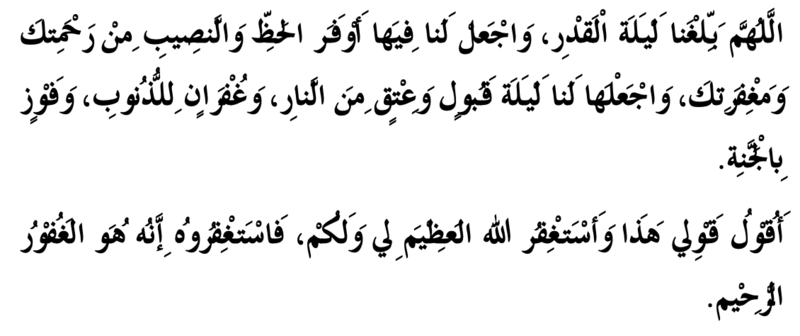
May Allah s.w.t. purify our hearts, preserve the rewards of our deeds, and grant us tranquillity and the opportunity to attain the blessings of Laylatul Qadr.
Second Sermon