


Majlis Ugama Islam Singapura
Friday Sermon
5 December 2025 / 14 Jamadilakhir 1447H
Cultivating the Practice of Self-Reflection
Zumratal mukminin rahimakumullah,
Let us adorn ourselves with taqwa towards Allah s.w.t. Ensure that every action we take aligns with His commands. Guard ourselves from transgressing His limits and prohibitions. Seek Allah’s help and guidance in all our affairs, for He is the best Protector and the Most Merciful towards His servants. May Allah s.w.t. grant us ease in our hearts and steadfastness in faith as we navigate the journey of life. Amin, ya Rabbal ‘Alamin.
Dear blessed congregation,
With each passing day, the end of the year is fast approaching. At the beginning of this past year, some of us may have set goals – what do we want to achieve over the course of the year? Yet, today, some of these plans may have not materialised, perhaps due to the demands of daily life or other distractions that pulled our attention away.
Amidst this busyness, we may not have found the time to take a moment to pause and ask ourselves – why am I doing what I am doing? What is my intention or purpose in life? How do my actions and work each day impact my standing in the Hereafter?
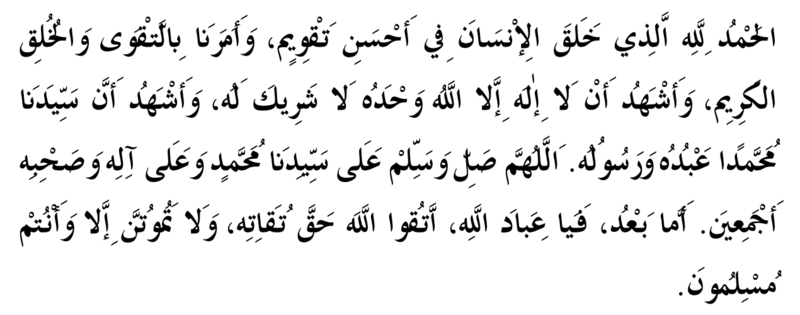
This is an example of introspection, or muhasabah, which is commanded upon every believer. Allah s.w.t. says in Surah Al-Hasyr, verse 18:

Which means: "O you who believe, fear Allah. Let every soul look to (or reflect upon) what it has put forth for tomorrow (the Hereafter), and fear Allah. Indeed, Allah is All-Aware of what you do."
In his tafsir, Imam As-Sa’di explains that this verse forms the foundation for every servant of Allah to engage in muhasabah or self-reflection. For this, he outlines three steps:
-
If we have made a mistake, correct it immediately. Abandon the mistake, repent sincerely, and avoid anything that may cause us to repeat it.
-
If we have any shortcomings in fulfilling Allah’s commands, always seek to improve. Ask for Allah’s help to refine and perfect our deeds.
-
Compare Allah’s blessings with our own deficiencies. When we recognise how vast Allah’s favours are compared to our shortcomings, it will lead us to feel deep humility and shame before Allah, and encourage us to be more obedient and grateful.
My dear brothers,
No matter how great our achievements are, there will always be room for self-improvement. Yet, we may miss the opportunities to reflect if we are always occupied and never pause to ask ourselves: Which areas need effort to improve? How can we plan ahead better so that our life’s goals remain clear and our good intentions are fulfilled?
That is why it is of utmost importance for every Muslim to practice muhasabah, or continuous self-reflection. Allow me to share two key points in this regard:
First: Muhasabah is a process of introspection that enlivens the believer’s heart
An eminent scholar, Al-Hasan Al-Basri, once said: “A believer continuously evaluates himself in every matter. Whatever he does, he feels there is still something lacking, therefore he regrets and holds himself accountable. As for the heedless and bad person, he lives on without ever questioning or correcting himself.”
Through muhasabah, a person humbles the ego and recognises his or her shortcomings. For example, we may, including myself, serve others courteously in public spaces, yet show less patience with our own family. We may exhibit good manners and pious deeds before others, yet commit sins in private. We are courteous to those similar to us, who share similar cultural background or views, yet may fail to treat others equally, forgetting that we are all creatures of Allah.
Thus, the practice of muhasabah ensures that we are not deceived by the small good deeds we manage to perform, for we are far from perfect and there remain many areas for improvement.
Second: Muhasabah for self-development
When we pause to self-reflect on our deeds and work, we may feel regret or disappointment when a noble goal has yet to be achieved, or a bad habit has yet to be abandoned.
The Prophet s.a.w. said that which means: “Regret is (the beginning of) repentance.” (Ibn Majah)
Feeling regret is important so that we avoid repeating mistakes in the future. We may regret wasted time that could have been used productively, or health that was neglected until illness struck. This regret should encourage us to be more conscious and intentional in our future actions.
Beloved congregation,
Muhasabah is not merely a process of improving our lives; it is also a preparation for the Day of Reckoning. As the saying goes:
“Hold yourself accountable before you are held accountable.”
Remember, every action we take carries weight in the sight of Allah. Muhasabah helps us fulfil our responsibilities at work, act with proper etiquette in society, and be patient in the face of challenges. It cultivates ihsan – living as if we see Allah, or at least, with full consciousness that Allah is always watching over us.
May our constant self-reflection guide us to become more aware, more grateful, and more intentional in our lives. May Allah s.w.t. lead every step we take toward attaining His pleasure. Amin, ya Rabbal ‘Alamin.

Second Sermon