



Majlis Ugama Islam Singapura
Friday Sermon
26 June 2026 / 10 Muharram 1448H
Asyura Through The Lens of Tadabbur

Zumratal mukminin rahimakumullah,
Observe taqwa of Allah s.w.t. Fulfil all His commands and abstain from all His prohibitions. May Allah s.w.t. ease our journey towards His pleasure, His forgiveness, and His paradise. Amin, ya Rabbal 'Alamin.
Dear brothers,
Today marks the final instalment of the Tadabbur Sermon series, and in conjunction with the Day of Asyura, a day which is associated with the event of Prophet Musa a.s. and his people being liberated from the tyranny of Fir’aun, let us together adopt the tadabbur approach and reflect deeply upon verse 6 of Surah Ibrahim:

Which means: And (remember) when Musa said to his people: 'Remember the favour of Allah upon you, when He saved you from Fir’aun and his people who inflicted upon you grievous torment, and who slaughtered your sons and let your daughters live; and in that was a great trial from your Lord.'”
Esteemed congregation,
At first glance, we understand this verse to be recounting how Prophet Musa reminded his people to remember Allah's help in saving them from the grip of Fir’aun's tyranny and his armies.
However, the tadabbur approach invites us to pose several questions:
Why was Prophet Musa a.s. commanded to remind his people of Allah's blessings and assistance? Because human beings are prone to forgetting Allah, as well as His blessings and various forms of help, once hardship and trials have passed.
People then begin to be deceived by their own greatness, assuming that everything they possess is the result of their own efforts, when in truth every blessing comes from Allah s.w.t.
Why did Allah link this reminder to the event of saving Prophet Musa's people from Fir’aun? Because human beings find it easier to appreciate blessings when they recall the hardships they once endured. When the Children of Israel remembered their suffering under Fir’aun’s grip, they would come to appreciate more deeply the blessing of freedom that Allah had granted them.
What is the connection between this verse and the Day of Asyura? As mentioned at the beginning of this khutbah, the Day of Asyura reminds us of the event in which Allah saved Prophet Musa a.s. and the Children of Israel from Fir’aun’s tyranny. When the Prophet s.a.w. saw the Jewish people fasting on that day, he asked them the reason for it. They explained that it was the day Allah granted victory to Prophet Musa a.s. and his people. The Prophet s.a.w. then said that which means:
“I have more right to Musa than you.” So the Prophet s.a.w. fasted on the Day of Asyura and instructed to fast on that day. (Al-Bukhari)
Blessed congregation,
Does the lesson of Asyura demand only that we fast?
Certainly not. For based on the tadabbur of verse 6 of Surah Ibrahim that we have been discussing, there are two lessons we can apply in our lives:
Firstly: Expressing gratitude beyond mere words on the lips.
The quality of gratitude teaches us to appreciate what Allah has already given, rather than preoccupying ourselves with what we have yet to possess. However, true gratitude is not confined to merely uttering “Alhamdulillah.”
When a person is truly grateful, that feeling must be translated into deeds and actions. The Jewish people in the time of the Prophet s.a.w. fasted on the Day of Asyura as a mark of gratitude for Allah's help. Likewise for us, gratitude must be expressed by using the blessings Allah has bestowed to do good. The wealth we possess, for example, can be used to assist those in need. The time we have can be used in serving our parents and family. The knowledge we have acquired can be used to guide and benefit society. This is how a believer remembers the blessings given and manifests his gratitude to Allah s.w.t.
Secondly: Cultivating compassion towards the burdens and trials of others.
Prophet Musa a.s. strove to free his people from the burdens of oppression and persecution they faced. Today, we as believers must likewise be attentive to the plight and hardships of others.
For in this day and age, life's trials can come in many forms — some occurring in the cyber sphere, some in the workplace, and some even within the home, such as physical, verbal and emotional abuse.
Going beyond the bounds of sympathy, a believer ought to strive to extend assistance according to his ability, such as reporting matters to the relevant authorities so that the rights of victims are protected. Indeed, Allah's help will certainly come. But at the same time, a believer must also endeavour to be part of that avenue of help by assisting and protecting those who are in difficulty.
Beloved brothers,
If the ummah of Prophet Muhammad s.a.w. has greater right to commemorate the Day of Asyura, then it is fitting that we remember Allah's blessings with full gratitude, and strive to become more attentive to the hardships of our fellow brothers and sisters.
This quality can be nurtured through a sustained relationship with the Quran, by reading and examining with tadabbur the messages contained within it, and not merely according to one's own personal understanding, but guided by the interpretations of established and reputable scholars of tafsir, so that our appreciation of it is sound, accurate, and becomes a nourishment that is spiritually effective.
With this, the Tadabbur Sermon series draws to a close. May the tadabbur approach shared over these four weeks provide us with lessons and guidance in shaping a life that draws us ever closer to Allah s.w.t. Amin, ya Rabbal 'Alamin.

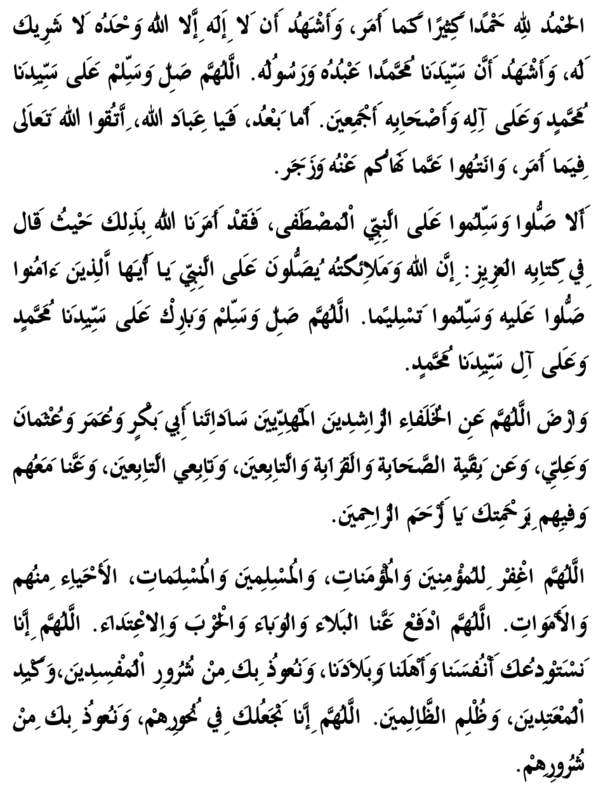
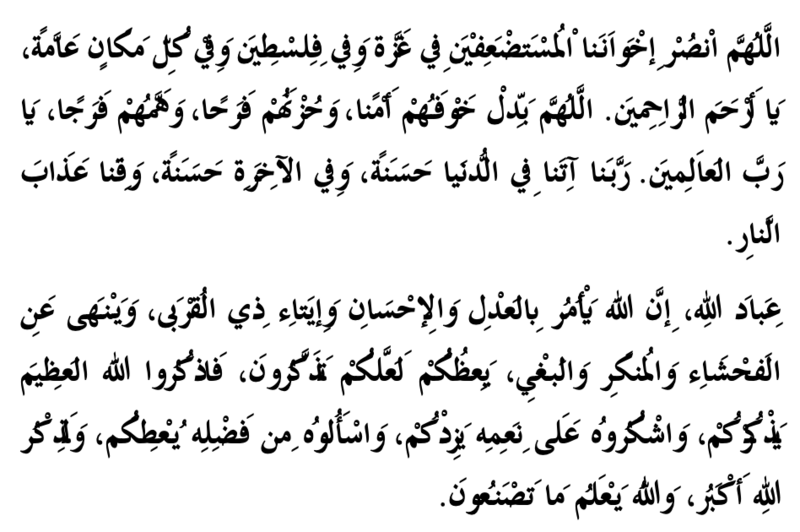
Second Sermon